latest
The New NPPF: From Faster Planning to Better Development
The Government’s new National Planning Policy Framework represents a significant shift in how England plans for the buildings and infrastructure that support economic growth.
For Chetwoods, one of the most important changes in the recently published framework is the clearer recognition of industrial and logistics development and data centres as essential components of a modern economy.
That recognition is welcome. But allocating more land and accelerating decisions will not, on their own, deliver the resilient infrastructure the country needs. The opportunity is to use planning reform to enable better, more adaptable development.
Designing for change
The new NPPF places greater emphasis on flexibility and adaptability, recognising that commercial requirements will continue to change.
This matters. The operational requirements of logistics buildings, data centres and other employment uses are evolving faster than traditional planning cycles. Automation, AI, energy systems, transport technologies and changing supply chains are already altering what buildings need to do. We therefore need to design not only for today's occupier, but for tomorrow's.
At Chetwoods, we increasingly consider adaptability from the outset: structure, servicing, energy, subdivision, expansion, alternative uses and the potential second life of buildings and materials. Planning policy that supports this flexibility should ultimately create assets that remain useful for longer.
Recognising logistics as infrastructure
The NPPF's stronger support for freight and logistics is particularly significant.
Logistics cannot simply be considered as a requirement for land and buildings. It is a connected system of transport, energy and infrastructure that increasingly needs to be considered at masterplan scale.
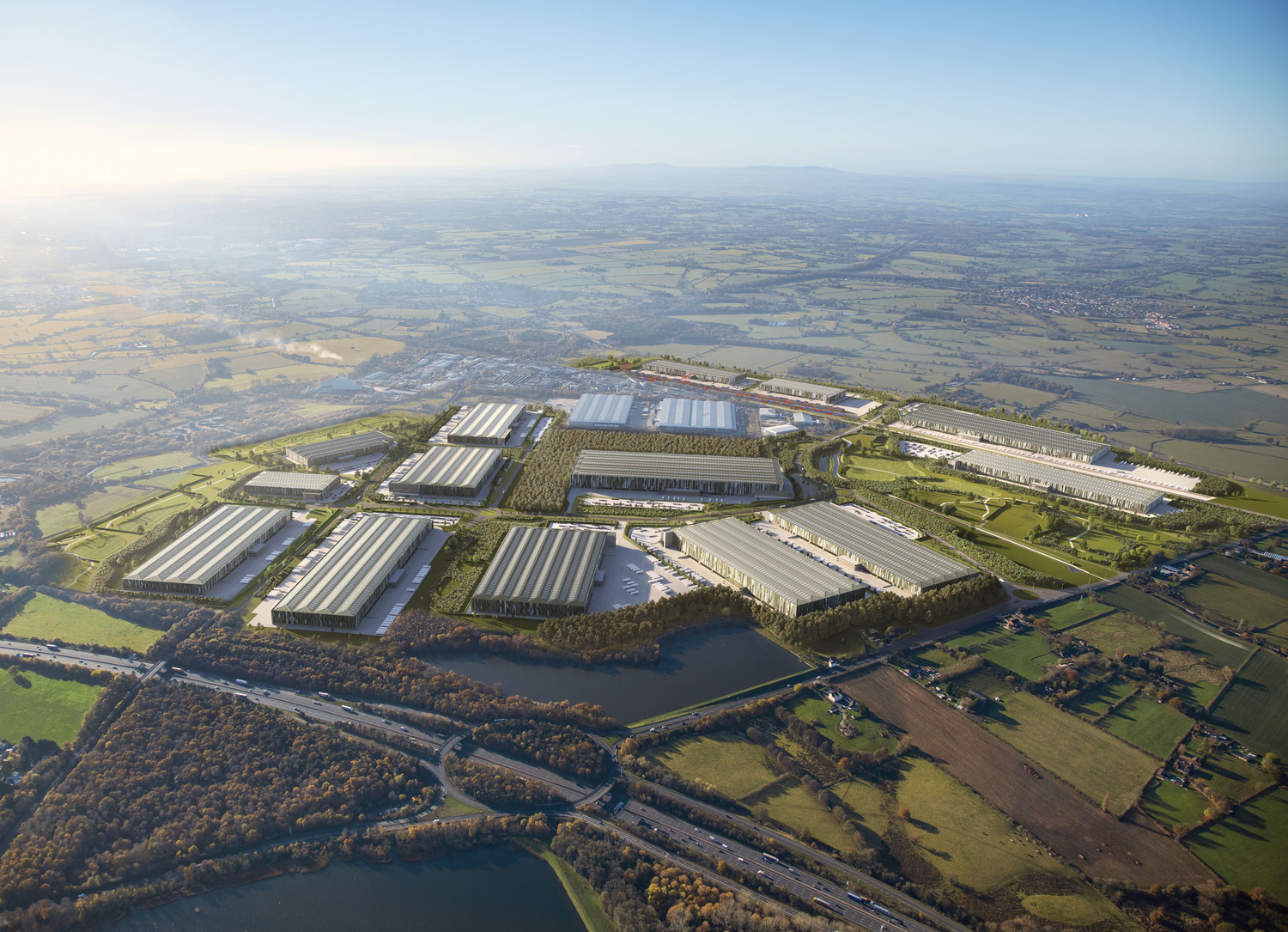
Our work at West Midlands Interchange (image above) demonstrates this approach, integrating logistics buildings with strategic rail and road infrastructure, landscape, ecology and energy rather than treating them as isolated objects.
The challenge now is to use the new policy support to encourage more of this integrated thinking.
For data centres, infrastructure comes first
The greater recognition given to data centres also reflects fundamental changes in that sector.
Power availability, grid capacity, water and connectivity can now determine viable locations before architectural design begins. This means architects, engineers, infrastructure providers, planners and operators need to collaborate much earlier.
It also increases the value of digital masterplanning and scenario modelling, allowing different combinations of energy, cooling, density, phasing and technology to be tested before development strategies become fixed.
Reuse and retrofit
The framework's support for the reuse of existing structures and materials also reinforces a wider shift towards circularity.
Through research including RESTOR, our structural timber programme and our work on retrofit, Chetwoods is exploring how the industry can retain more of the value already embodied in buildings and their components. Rather than beginning with an assumption of demolition and replacement, development should increasingly start by asking: what can be retained, adapted, intensified or reused?
From reform to better places
Greater certainty and faster decision-making should be positive for development, but speed should not come at the expense of design quality.
For large industrial, logistics and data centre projects in particular, architecture, landscape, biodiversity, transport and energy need to be considered as one interconnected system.
The new NPPF creates a stronger framework for growth. The opportunity now is to translate that policy into better development: identifying infrastructure constraints earlier, using land more intelligently, designing for adaptability and embedding carbon, nature and community impact from the outset.
If it achieves that, the legacy of planning reform will not simply be faster development. It will be development that is better prepared for what comes next.
Share this insight
Related projects
%20copy.avif)


